Buy Better Light Before You Buy Another Sweater
There's a particular disappointment that happens in a fitting room or a hallway mirror: the sweater looked richer online, the trousers looked sharper on the hanger, and in the bathroom you look vaguely unwell. Nine times out of ten the clothes are fine. The light is not.
We spend enormous energy on what we wear and almost none on where we see it. But light is the first accessory in any outfit — it decides which colors read as expensive, which textures look cheap, and whether the whole thing lands. Rooms behave exactly the same way. Fix the light and both problems solve themselves at once.
The Overhead Light Problem
The average American rental — and plenty of owned homes, too — comes with one central ceiling fixture per room. It's efficient, it's cheap, and it is the least flattering light ever installed in a house. Light from directly above does three unkind things: it drops shadows under the eyes and nose, it exaggerates every texture in the fabric and the skin, and when it's a cool white bulb it drains warm colors until brick reads brown and camel reads gray.
Designers call this flat light, and the fix is not a stronger bulb. It's more light sources, placed lower.
Color Temperature, Without the Physics
Bulbs are rated in kelvin, and the useful range is narrow. Around 2700K is warm and faintly golden — the light of a lamp at eight in the evening, the light that makes wood look like wood. 3000K is neutral-warm and suits kitchens and bathrooms where you need to genuinely see. Anything at 4000K or above reads blue-white and belongs in an office, a garage, or nowhere at all.
The second number is CRI, the color rendering index. Under 80, reds turn muddy and skin goes gray. Look for 90 or above, which is now easy to find and no longer expensive. And buy dimmable, always. One bulb you can turn down is worth two you can't.
Three Pools of Light
The rule that changes a room fastest: one light is never enough, and none of them should be overhead-only.
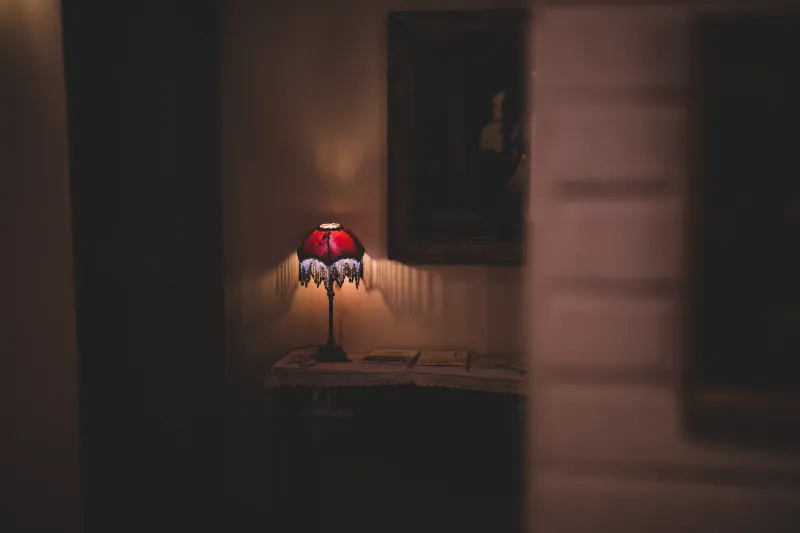
Think in pools. A table lamp beside the sofa. A floor lamp behind a reading chair. A small lamp on a console in the hallway. Three separate glows at roughly seated eye level, and the room suddenly has depth, corners, and a mood — the same effect candlelight has on a dinner table, for the same reason. Overhead light flattens a space. Low light sculpts it.
That's also why getting dressed in a room lit by three lamps is easier than getting dressed in a room lit by one. You see the fabric the way other people are going to see it.
The Mirror Is Half the Equation
Placement matters more than the frame. A mirror facing a window turns into a wall of glare; a mirror hung perpendicular to the window catches soft side light, which is the most forgiving light there is. In a bedroom, that usually means the wall beside the window rather than the wall opposite it.
Then look at what's above the mirror. If it's a downlight, you're back to shadows. Swap it for two small sconces at face height, or angle a lamp so the light bounces off the wall and comes back at you indirectly. That bounce is the trick photographers use, and it's the reason a hallway bulb can't rescue an outfit.
Frame-wise: thin brass, blackened steel, or pale wood. A heavy ornate frame competes with whatever you're wearing; a quiet one disappears.
Shades, Bulbs, and the Cheap Fixes
Shade material does more work than most people realize. Linen, cotton, and paper diffuse and warm the light. Metal and dark glass throw it in a hard cone. If a lamp is glaring, the cheapest fix on earth is a new linen drum shade.
In closets, skip the single center bulb and run a warm-white LED strip under the shelf line. You'll finally see color accurately, and you'll stop dressing in the dark at 6:45 in the morning.
And if you rent: a plug-in wall sconce, a screw-in dimmer, and one good table lamp will do more for the room and your morning routine than a renovation ever could.
What to Actually Buy
- A table lamp with a linen or paper shade, 16 to 20 inches tall, dimmable, warm bulb
- A floor lamp with an adjustable arm — good for reading, better for throwing light at a wall
- Warm LED bulbs at 2700K, CRI 90+, dimmable. Buy a six-pack and replace everything
- Plug-in sconces for renters, hardwired for everyone else
- A slim-framed mirror, hung perpendicular to the window
- A warm strip light for the closet shelf
- A screw-in dimmer for the lamp you already own
None of it is glamorous. All of it changes how a room feels and how you feel in the clothes you put on inside it. Buy the light first. The sweater will look better than it did online.